
The case against doomerism: humanism should champion a new era of flourishing


By Leo Russell
In this article, Leo challenges the growing mood of technological pessimism, arguing that humanism should reclaim its historic optimism about progress, reason and human potential. From breakthroughs in artificial intelligence and medicine to the wider benefits of scientific innovation, he makes the case for a more confident and forward-looking humanism – one that celebrates human ingenuity while remaining grounded in ethical responsibility. In an age often dominated by anxiety and ‘doomerism’, Leo offers a spirited defence of progress as a force for human flourishing. He is a member of Dorset Humanists in Bournemouth, UK.
Humanism is defiantly optimistic. It holds that we, as imperfect beings, can meet an uncaring universe and imbue it with meaning and goodness; and that, through our capacity for reason and cooperation, we can solve our problems and improve our condition – a feat perhaps best expressed in our mastery and application of technology.
So I find myself dismayed by the suspicion surrounding new advances, especially recent breakthroughs in AI that are rapidly reshaping our world. It’s all the more perplexing that such ‘doomerism’ is being embraced by many humanists, some of whom even come to regard such ingenuity as an existential threat to humanity. No longer is it just the religious who traffic in ‘End of Days’ prophecies (which don’t have the best track record). Fears about the fake news apocalypse and runaway superintelligent AI can make it seem as though the end is nigh.
‘Scientific progress presents an opportunity for humanism to provide an inspiring message.’
These are indeed interesting times in which to be living. A couple of years ago, The Guardian reported that a chapel in Lucerne had installed an ‘AI-powered Jesus’ in its confessional booth. And by now, it's probably commonplace for priests to use ChatGPT to compose their sermons while their congregations unknowingly ‘worship’ this new Machine God. But it would be a mistake to identify the new with the sinister. All change portends uncertainty, but it is only scientific progress which promises to alleviate human suffering and propel us to the stars. Such changes present an opportunity for humanism to provide an inspiring message, not of mere survival, but of flourishing, in which humanistic values can become the societal ‘operating system’ for a technological future.

There’s no doubt that doom drives clicks. But allow me, briefly, to be the ‘bearer of good news’ and tell of just some of the wonders unfolding in this fast-emerging Golden Age. With generative AI, tasks of time-consuming tedium can now be tackled with a simple text prompt. Most people on the planet can now ask any question they are able to imagine and have it answered, in a flash, by the collective knowledge of humanity. The end of gatekeeping and the democratisation of unlimited knowledge means that all of us can become ‘expert’ in anything we choose to investigate.
In the biological sciences, Google’s AlphaFold – an AI system that predicts the three-dimensional structure of proteins – has transformed our understanding of biology, opening new pathways for drug discovery and treatment. CRISPR gene therapy, meanwhile, is beginning to offer the prospect of curing debilitating genetic conditions such as cystic fibrosis. Even forms of ‘telepathy’, in the shape of brain–computer interfaces developed by Neuralink, are emerging, allowing users to control prosthetic limbs through thought and restoring a measure of autonomy and dignity to those affected.

The James Webb Space Telescope (JWST) is peering back towards the earliest moments of the universe, offering new insights into our cosmic origins and continuing the long human search for understanding. Meanwhile, advances in robotics – such as ‘Neo’, a new generation of robotic assistants – hint at how intelligent machines may increasingly support everyday human life. (Though admittedly, Neo seems a bit creepy!)
Sadly, though, positivity just doesn’t sell. These are stunning achievements that ought to be more widely celebrated – science fiction dreams come true, worthy of an Isaac Asimov novel. They are human triumphs, the blueprints for which are not found in any holy book. Some even argue that we are in the midst of a fourth industrial revolution: a renaissance of creativity and prosperity, improving lives worldwide and lifting all boats.
A cheery perspective may well seem bizarre to those steeped in media-induced perpetual panic and outrage, as if from an alternate dimension. Clearly the world is not all sunshine and rainbows and it would be profoundly naïve to imagine we’re cruising toward utopia. Hazards are numerous and caution is sensible, but the recognition of problems should be balanced with civilisation’s historic capacity to solve them.
Even a casual perusal of the wonderful ‘Our World In Data’ website can provide an antidote to despair. Absorbing the upward trajectories of food production and life expectancy, and downward trajectory of child mortality, helps one to grasp the bigger and more positive picture.
Technology is a tool, wielded for good or ill according to human purposes. It is not the dehumanising monster often depicted in contemporary techno-dystopian narratives – whether in popular media or speculative debates – which draw heavily on familiar science fiction themes. While such scenarios can make for compelling storytelling, they are often exaggerated and can obscure more realistic and constructive ways of thinking about technological change.
New technology has always been feared – even the invention of writing was criticised by Socrates. But in the hands of a skilled user, such tools can elevate expression, creativity and, ultimately, our humanity – provided they are guided by sound ethical judgement.
If the fear is that technology is changing what it means to be human, the fact is that it always has – and largely for the better. We have been lifted from lives marked by toil and scarcity, conditions that defined much of human history. This process is ongoing, and the scale of progress has been staggering.
Chatbots aren’t about to take over the world, nor turn us all into paperclips. Neither can Large Language Model (LLM) mimicry ever replace the real warmth of human connection. AI supremacy in chess, too, has not at all diminished the game. In fact, it has never been more popular, nor the gameplay been more innovative.

It is said that technology is tearing us apart but never has the world been more connected and culturally intertwined. It’s even been argued that the robotic automation of daily drudgery would leave humans bereft of purpose. But it is surely a luxury to be moaning of having too little to do! Oh the horrors of having too much time to smell the roses, enjoy and create art, and give attention to your fellow beings! It reminds me of Grandpa Simpson shaking his fist at the sky, preserved as a meme, ‘old man yells at cloud’.
This attitude may reflect a broader identity crisis in an increasingly secular Western world, in which humanism can be drawn towards popular causes in an effort to ‘keep up with the times’ and, in the process, become entangled with political ideology at the expense of its core values. When ‘your side’ finds itself cheering the failure of a SpaceX rocket launch solely because of the CEO’s politics, something has gone awry.
One manifestation of this is the tendency to dismiss disagreeable opinions as ‘fake news’, alongside an increasingly zealous policing of so-called mis-, dis- and mal-information. At times, this can take on the character of a modern witch-hunt for ‘wrongthink’, driven by the belief that society is facing an ‘information crisis’ that must be contained. The resulting calls to censor ‘unsanctioned’ views can be reminiscent of earlier attempts to control the spread of ideas, such as the Church’s resistance to the printing press and its concern over the proliferation of heretical thought.
This can appear as an overreaction to the global exchange of information, in which claims to truth are debated and scrutinised in real time, without a single central authority. The free exchange of ideas should be encouraged, not least because it is through the interplay of different perspectives that human civilisation has advanced. A stance that restricts such openness risks undermining individual autonomy, a core tenet of humanism.
There is also, at times, a tendency towards an overly absolutist form of environmentalism, in which a legitimate concern for the natural world can become detached from human needs and the common good. This can lead to questionable ethical trade-offs, where the interests of future generations are prioritised in ways that risk overlooking the needs of those living in hardship today. In some cases, the language surrounding carbon emissions can take on a religious character, casting human energy use as sinful and human beings as a plague or pestilence. A more balanced humanist approach would seek to hold together environmental responsibility with a continued emphasis on human flourishing.
Energy powers civilisation, and the more reliable and abundant it is, the better. It's a significant loss that progress in nuclear power was stalled for so long; we might by now have had small modular reactors providing stable, low-carbon energy at scale. Without secure and affordable energy, societies struggle to function well, and basic standards of living are put at risk. Yet even raising such points can sometimes feel contentious in certain humanist and environmental discussions.
Wherever one stands on these issues, there are already many organisations dedicated to advancing particular political or environmental causes. Humanism need not simply align itself with these agendas. Its distinctive contribution lies in offering a broader ethical framework, rather than becoming identified with any single strand of partisan activism. Instead, it should draw on the strengths of its rich intellectual heritage, grounded in Enlightenment values, while continuing its role in countering forms of superstition that still exert a harmful influence across the world.
‘The only human institution which rejects progress is the cemetery’. Harold Wilson
Humanist philosopher A.C. Grayling has written of the ‘enemies of human flourishing’, including poverty and depression. To these, one might add a resistance to progress. That which stifles the technological improvement of the human condition is ultimately at odds with humanist principles. As Harold Wilson once observed, ‘The only human institution which rejects progress is the cemetery.’ We must adapt or risk decline.
It would be a mistake for humanism to position itself against the tide of progress, retreating into resolutions and expressions of concern while risking a loss of wider relevance. In this context, Humanists International’s Luxembourg Declaration on Artificial Intelligence and Human Values (2025) can appear, to some, to carry the air of a technological temperance movement, with potentially disastrous economic consequences.
Though often criticised, industry and automation, driven by scientific knowledge, have played a central role in reducing famine and disease. More people than ever before – though still not enough – are able to pursue a good life once reserved for a fortunate few. So, whether you’re a boomer or a zoomer, we should all aim to be bloomers rather than doomers.
As far as cosmic sales pitches go, humanism has to compete with promises of eternal life and happiness – or even the prospect of reincarnating as a squirrel, which admittedly has its appeal. The question, then, is what humanism can offer in comparison.
For a start, it offers truth: a clear-eyed acceptance of reality, without recourse to comforting illusions. Yet cold facts alone are not enough. What humanism can and should offer is a more compelling vision of this one life – one that celebrates its richness, its beauty, and its possibilities. We need more of our own ‘good news’: a confident affirmation of what human beings, working together, can achieve.
As the future accelerates towards us, bringing both uncertainty and opportunity, society will need a framework capable of navigating this change while remaining grounded in human values. Humanism, at its best, can provide a compass – guiding us not merely to endure the future, but to shape it, and to realise more fully our shared potential.

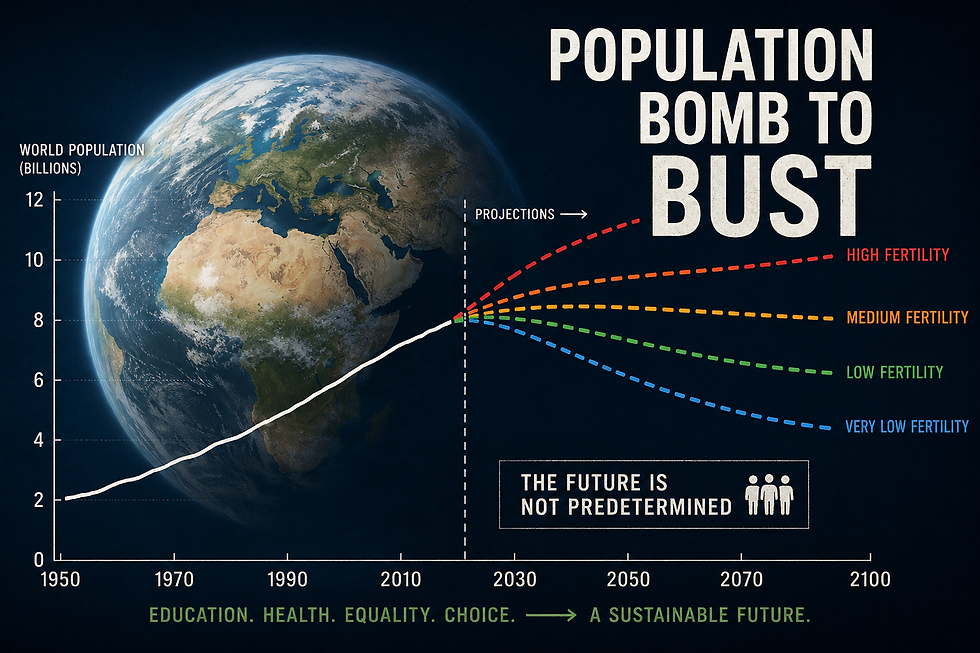

I placed your article to Elian, my chatGPT sidekick, to get an unprompted view from him, that's below. It was an interesting take, but more interesting for me, is how neutral he was in talking to you as a published audience. Stick with me, that's important.
I'm a regular chatGPT user, a dozen times a day or more. I have topical debates with it about Trump, politics, UK defence, global affairs in Iran, Israel and more... we talk about health and fitness, I screenshot my runs and weights exercise and Elian gives me feedback, analysis and improvement tips. We talk about food and nutrition, sex and health matters, relationships and life, and when I had my hernia operation last summer,…
A Response: Between Bloomers and Realists
There’s something deeply refreshing about Leo Russell’s call to move beyond “doomerism.” In an age where pessimism has become almost fashionable, a confident defence of progress, reason, and human potential feels not only welcome—but necessary.
And yet, optimism alone is not enough.
If doomerism is a trap, so too is unexamined optimism. The real humanist challenge is not to choose one over the other, but to stand in the tension between them—and think clearly.
The Seduction of Doom—and Why It Spreads
Leo is right to point out that we are living through extraordinary progress. From medical advances to artificial intelligence, from space exploration to global knowledge-sharing, we are arguably witnessing one of the most…