
Resisting the menace of sectarianism


By Dr Anthony Lewis
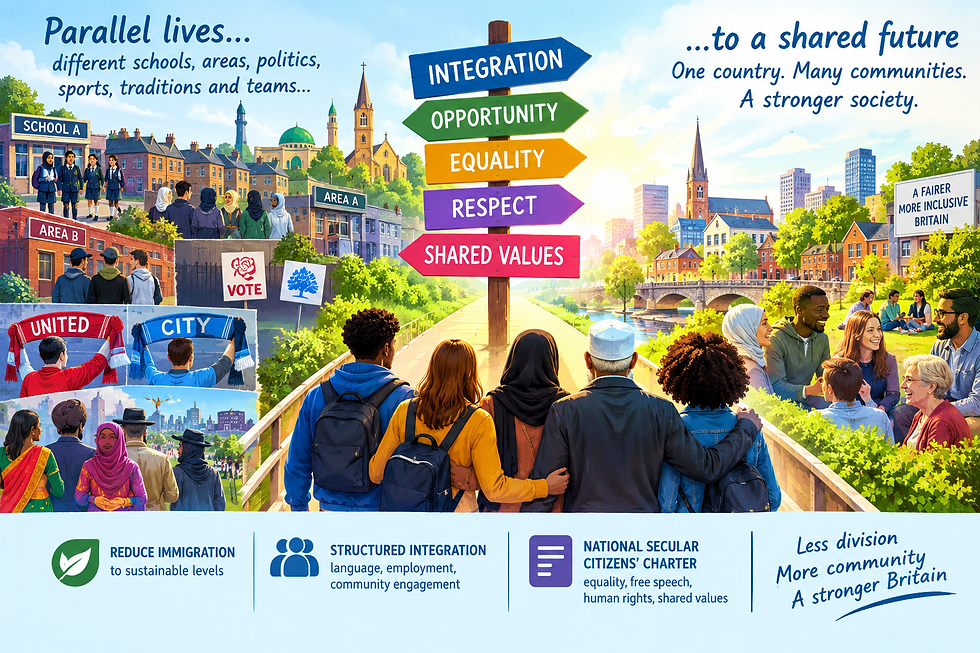
Is Britain becoming a more sectarian society? Drawing on his experiences in Northern Ireland and elsewhere in Britain, Anthony highlights the dangers to social cohesion when different ethnic and faith communities lead separate, parallel lives with little interaction. To counter this systemic segregation, he advocates reducing immigration to sustainable levels, introducing a structured integration programme, and establishing a national secular Citizens’ Charter to promote shared democratic values.
Anthony is Chair of Windsor Humanists.
History teaches us that when religion becomes closely tied to politics and cultural identity, it can become a powerful source of division, and undermine social cohesion. This is especially true when different faith communities live parallel, separate lives with little interaction: attending different schools, living in different areas, supporting different political parties, playing different sports, following different cultural traditions, and even supporting different football teams. My own experience of growing up in Northern Ireland during the Troubles provides one example. Religious and communal divisions have also contributed to conflict elsewhere in the world, including between India and Pakistan, in Israel and Palestine, and in the persecution of the Rohingya in Myanmar and the Uyghurs in China. Although the causes of these conflicts differ, they all illustrate the dangers of identity-based hostility and exclusion.
The separation of communities into enclaves based on religion, ethnicity and culture leaves all sides vulnerable to growing mutual suspicion. Such sectarian divisions can easily be exploited. It takes only a violent minority on either side to light the touchpaper and trigger inter-communal violence. As a result, in a society divided along sectarian lines, communal strife is often never far away. Once the cycle of violence begins, often over a relatively minor pretext, divisions can deepen very rapidly. Violence hardens sectarian differences, making them extremely difficult to address, even over generations. Such is the longevity and power of ‘communal victimhood’ and historical grievances.
As an English Catholic growing up in Northern Ireland, my mixed background meant that I did not easily fit into either of the two sectarian traditions. As a result, I was able to remain non-aligned. I still have close, lifelong friends from across the divide. To this day, however, I remain bewildered by how deeply entrenched, rigid and long-lasting sectarian differences can divide a society so completely that violence comes to be justified. Unfortunately, sectarianism remains deeply rooted in Northern Ireland and continues to threaten peace, even over 25 years after the Good Friday Belfast Agreement. This is partly because there have been few, if any, formal attempts at reconciliation and desegregation. In some respects, the peace settlement has actually hard-wired existing sectarian divisions into the institutions of the power-sharing government. This has reinforced deep-seated differences rather than diminished them. Over the past 25 years, the two traditions have spent more time asserting themselves than reaching across communities to seek reconciliation. It would not take much for violence to return, as the recent disputes over summer marches in 2026 have highlighted.

Based on my experiences in Northern Ireland, I believe Britain could be heading towards an even more complicated, multifaceted sectarian fragmentation, which could in turn lead to sectarian violence, as happened in Northern Ireland in the late 1960s. That is, if these developments continue to be ignored and their emergence is not actively resisted. The UK population has increased by nearly 12 million over the past few decades, largely as a result of net immigration from many parts of the world, bringing a wide variety of ethnicities, beliefs, religious practices and cultural traditions. Slough, near where I live, is one of the most diverse areas outside London. The scale and speed of these demographic changes are unprecedented in UK history. Their pace and scale are placing considerable pressure on the British state, local government institutions and wider civil society.
There have been several well-researched reviews of these issues and the associated risks. These include the Commission on Race and Ethnic Disparities, chaired by Tony Sewell (Lord Sewell of Sanderstead) and published in March 2021, and the earlier report, Living with Difference, published by the independent Commission on Religion and Belief in British Public Life, chaired by Elizabeth Butler-Sloss (Baroness Butler-Sloss). (Links for both are provided below). These reviews made numerous recommendations on how to address the growing pressures, promote integration and prevent the UK from becoming divided into sectarian and ethnic enclaves. However, few of these recommendations have been implemented effectively. In many cases, the reports have been ‘shelved’ or almost completely ignored.
Personal experience
I would like to present three examples from my own experience that help illustrate the increasingly multifaceted sectarian divides in the UK. Here, I use the term ‘sectarianism’ in its broadest sense, following the Oxford Dictionary definition: a narrow-minded and rigid adherence to a particular sect – political, ethnic or religious – often leading to intolerance or conflict towards people with different affiliations or beliefs. At the end of this article, I also suggest some minimum measures that could help prevent any further descent into sectarianism and address it where it has already emerged.
Rochdale — a divided town: My husband is from Rochdale, where more than a third of the population is now Muslim, mainly of Pakistani origin. In several wards, Muslims make up more than 80% of the population. There is limited interaction between the white British population and the newer Muslim community outside formal political and interfaith settings. Our family in Rochdale lives what is, in effect, a parallel existence alongside its newer neighbouring communities. They avoid expressing public views about demographic changes in their home town for the sake of ‘community cohesion’. Nevertheless, there is a general sense of bewilderment about many aspects of the changes and their impact on the town.

For example, none of the taxi companies implicated in the Rochdale child sexual exploitation scandals has lost its licence to operate. Individual taxi drivers have been sanctioned and imprisoned, but the taxi firms implicated in the cases continue to operate in the town. This was one of the first such grooming cases to be brought before a UK court. The issues were portrayed in the 2017 BBC drama Three Girls and the related documentary The Betrayed Girls. (links below). There are still few mechanisms for the two communities to interact in any meaningful way. Initiatives that do take place tend to focus on building wider understanding of the Muslim community, with little attention or funding devoted to helping newer communities integrate and better understand established UK culture.
East Berkshire — a divided area: Over the past ten years or so, I have spoken at more than 50 local schools, both as a Humanists UK speaker and independently as a scientist. I have witnessed considerable diversity across East Berkshire. Some schools, for example in Ascot or Bracknell, are 95% white British, and in the classroom most pupils – typically more than 60%, and in some cases all of them – come from non-religious families. By contrast, I have spoken at schools in Slough where more than 80% of pupils come from recently arrived immigrant families, and the majority are from religious households, often more than 90%. The contrast is stark.
It has been a privilege and an honour to speak to young people from such a broad range of backgrounds. I usually find pupils engaged with what I have to say about humanism and science, and I am always impressed by the school facilities and by the professionalism and dedication of the teachers I meet. However, I have noticed some trends over the past decade. For example, most girls in majority-Muslim schools in Slough now wear the hijab at school, whereas when I began speaking in schools in 2014, almost none did. I do not know whether this represents a process of radicalisation, but it may indicate stronger identification with their Islamic faith and increased social pressure to dress modestly. As a humanist, I find any increase in such religiously-motivated gender segregation concerning.
During one classroom session on humanism at an Islamic school in Slough, pupils were incredulous to learn that Muslims make up only about 7% of the UK population. They insisted on checking the 2021 Census data online during the session, which confirmed the figure I had given them. This led to a valuable discussion about how growing up in Slough had given them an inaccurate impression of the religious make-up of the UK as a whole. However, we concluded that it was difficult to see what they could do themselves to broaden their contacts beyond Slough and gain a better understanding of how their own religious and cultural backgrounds fit within wider UK society. In my view, this disconnection is a serious issue that needs to be addressed.
Interfaith panel – a chilling silence: I recently experienced how difficult it can be to tackle sectarianism in practice. I took part in an interfaith panel at a local secondary school. Pupils had submitted written questions anonymously on slips of paper, from which we were to select questions to answer at an assembly attended by around 200 pupils. The questions about humanism were the usual fare, and I quickly selected a shortlist. One example was, ‘If you don’t believe in God, what do you believe?’
I noticed that the Jewish rabbi had divided his questions into two piles. I asked him why, and he invited me to read the questions in the larger pile. They were all antisemitic. He said he had thought he was there to talk about his faith and left before the assembly began, saying that this had always been his intention. I was the only person who expressed concern about the situation. There was clearly little appetite in the preparation room for discussing, let alone addressing, the antisemitism. I suggested to the teacher in charge that perhaps questions should not be anonymous in future, but that was as far as I went in acknowledging the need to address the issue.
All the adults involved appeared to prefer silence to confronting the anti-Jewish sectarianism demonstrated by some of the pupils. The subsequent interfaith session at the assembly went well, but the experience – and the fact that the antisemitism had not been addressed – left me unsettled. I suspect the pupils’ questions reflected sectarian attitudes within their own communities and family backgrounds. This illustrates how difficult it can be to challenge casual sectarianism, especially in a school setting. None of us wants to undermine ‘social cohesion’ in our local communities by speaking out.
The UK Government-sponsored Independent Review into Antisemitism in Schools (link below), led by former Ofsted chief inspector Sir David Bell, was published in October 2026. The review concludes that antisemitism is a serious safeguarding issue in many UK schools and that this form of sectarianism needs to be tackled. It recommends clearer guidance requiring teachers to remain politically impartial in the classroom, as well as formal training on how to address antisemitism. In my view, this is an encouraging step, provided the recommendations are implemented. Based on my own experience, local schools need to be reminded that antisemitic sectarianism has no place in education, that it must be addressed and that ignoring it is unacceptable.
These three very different examples illustrate how sectarianism is growing in the UK. This is evident both in the physical segregation of faith communities into religious and ethnic enclaves, and in the widening range of cultural practices and norms found among the UK’s many faith communities. Some of these may be difficult to reconcile with one another, while others are clearly unacceptable in a secular democracy and are often already illegal – for example, child marriage, forced marriage, so-called honour killings and domestic violence. As Northern Ireland demonstrates, geographical and cultural differences, combined with physical segregation into enclaves, can harden into intractable sectarianism over time if they are not addressed. This can lead to growing suspicion and tension between communities and, ultimately, violence, as the recent conflagration in France demonstrates. What, then, can be done to counter rising sectarianism in the UK before it is too late?
Tackling sectarianism
As The Times has highlighted, the figures on the pace and scale of recent immigration into the UK are striking (Link below). One in five people living in the UK – around 13 million people – was born abroad. This proportion rises to more than 40% in London. The UK’s ability to absorb large numbers of immigrants without adverse effects on society and social cohesion has its limits. By default, the UK has adopted a relatively laissez-faire approach to managing the large-scale increase in immigration over recent decades. As a result, significant ethnic and religious enclaves have developed in many major cities, with limited interaction between newer immigrant communities and established communities. Given the complexity of integrating people from such a wide range of backgrounds, beliefs and cultures, the UK has clearly struggled to integrate many newcomers effectively. The divisions in Rochdale, for example, are ‘baked in’ for the foreseeable future. Rochdale is just one of many examples that demonstrate how difficult matters can become when immigration is not managed in a way that supports newcomers’ integration into UK society.

The rise of sectarianism in UK politics is being fuelled by the continued growth of segregated religious communities, placing further pressure on social cohesion. Examples include the election of Islamist MPs, the emergence of Christian nationalism and the Green Party’s adoption of the ‘Zionism is racism’ policy. Some political parties are now cynically exploiting these divisions by seeking endorsements from local faith leaders. This approach was a key aspect of the Green Party’s campaign in the recent Gorton and Denton by-election. As National Secular Society chief executive Stephen Evans said, ‘this is a dangerous and divisive road to go down’. The risk and dangers of sectarianism becoming embedded in UK politics and wider civil society should not be underestimated, and it must be resisted.
Tackling this growing sectarianism will not be easy. It will require political will and sustained determination to implement, at a minimum, the following measures, all of which have been recommended by the various commissions and reviews mentioned earlier.
Short term: Reduce current immigration levels – Given the growing emergence of sectarian politics in the UK, continuing immigration at its current scale would be irrational. It is imperative that both legal and illegal immigration be reduced significantly to sustainable levels, with short-term immigration focused on filling critical skills shortages in the economy. This would give the UK Government breathing space to tighten asylum procedures and improve immigration systems that have clearly been overwhelmed in recent years. The current Home Secretary, Shabana Mahmoud, is attempting to do this with some success. A reduction in overall immigration would also help ease pressure on public services and budgets, while giving the UK time to put more robust and workable integration policies in place.
Medium term: Develop and implement an integration plan – The UK needs to develop and adopt an effective integration process for future immigration. The current laissez-faire approach has contributed to serious and long-lasting divisions within UK society. A more structured approach is needed. Denmark introduced a new Structured Integration Framework for migrants in 2024 (link below). The programme can last up to five years and includes compulsory language tuition, employment training and community engagement. An important element is the dispersal of newcomers to prevent ghettoisation and limit the development of so-called parallel societies, in which migrant communities become disconnected from wider Danish society.
Newcomers are also expected to adhere to core secular democratic values, including equality, women’s rights and the primacy of individual freedom. The new policies place greater emphasis on the eventual return of refugees when conditions in their countries of origin improve and international law permits it. As part of their integration strategies, both Sweden and Denmark have also introduced repatriation policies with compulsory elements for people who have breached the terms of their residence or citizenship, alongside voluntary schemes offering grants to immigrants who wish to return to their countries of origin. These policies, developed on a non-partisan basis by the Danish government, have been successful and have helped reduce the prominence of immigration as a political issue.
Long term: Implement a Citizens’ Charter process – A formal process is needed to engage with existing segregated communities so that everyone in the UK understands the fundamental principles underpinning our democracy and society. This should include explaining the key foundations of the UK’s constitutional monarchy, including equality before the law, freedom of speech and assembly, tolerance, and the primacy of individual human rights over collective rights. It should promote a broad understanding that, in a secular democracy, there is freedom of religion but also freedom from religion, and that no faith has the right to impose itself on non-believers.
Perhaps this could best be achieved through a structured citizenship education programme rolled out across schools, civic institutions and communities throughout the UK. School-based programmes could include twinning arrangements that allow pupils to build formal connections with young people from different ethnic or religious communities. This could lead to a formal ‘Citizens’ Charter’ accreditation for individuals and a ‘Civic Charter’ kitemark for organisations. The process could be administered by the Crown to ensure that it remains politically impartial and independent of political pressure. In addition given that 40-50% of white british are now non religious according to the 2021 UK Census and British Attitude Surveys, the process has to be secular in order to include the non religious population.
Such a civic process would help people from diverse backgrounds and communities commit to, and feel part of, wider UK society by embracing a set of shared democratic and secular values that transcend the religious, ethnic and political differences.
Links
Commission on Race and Ethnic Disparities, chaired by Lord Sewell of Sanderstead, 2021
Living with Difference, Commission on Religion and Belief in British Public Life, chaired by Elizabeth Butler-Sloss (Baroness Butler-Sloss) 2015
Independent Review into Antisemitism in Schools, led by former Ofsted chief inspector Sir David Bell, was published in October 2026.
BBC drama Three Girls and the related documentary The Betrayed Girls 2017
The Times Editorial on the pace and scale of recent immigration into the UK 21st October 2026
Denmark Structured Integration Framework for migrants 2024
British Social Attitudes by the National Centre for Social Research


Comments